
Asking vs. Sharing Paradigms
How friendly conversations can misfire
Back when my partner’s parents were getting engaged, my father-in-law’s family traveled to visit my mother-in-law’s family in a different state in India. When they arrived, my mother-in-law’s family politely served them sweets, as is their custom when welcoming guests. My father-in-law’s family then politely departed, since according to their own custom, sweets being served signals the end of a visit.
Most of us share a desire to be polite (at least some of the time ;), and we can even mostly agree on the general goals of politeness: to communicate respect and kindness, and to help the other party to feel comfortable. But what if we have different understandings of what this should look like, and how it should work?
Maybe you’ve experienced one of the following frustrations (but, most likely, only one of them):
Scenario One: You’re trying to carry on a friendly conversation with someone, and showing interest in them by asking them about themselves. But as you keep coming up with more thoughtful questions about their background and interests, in order to draw them out, they rarely ask you anything in return! Why are they letting this conversation turn into an interview? Why don’t they recognize the generosity of the effort you’re making to draw them out, and return the favor? Maybe they’re just not interested in getting to know you better.
Or, Scenario Two: You’re trying to carry on a friendly conversation with someone, and sharing stories in order to build rapport. But as you open yourself up more to them, they do not seem to reciprocate! They keep you in the hot seat with question after question, until you start to feel uncomfortable. Why has this conversation turned into an interview? Why don’t they recognize the generosity of the effort you’re making to open up, and return the favor (so you at least know what’s okay to ask about)? Do they not feel comfortable around you?
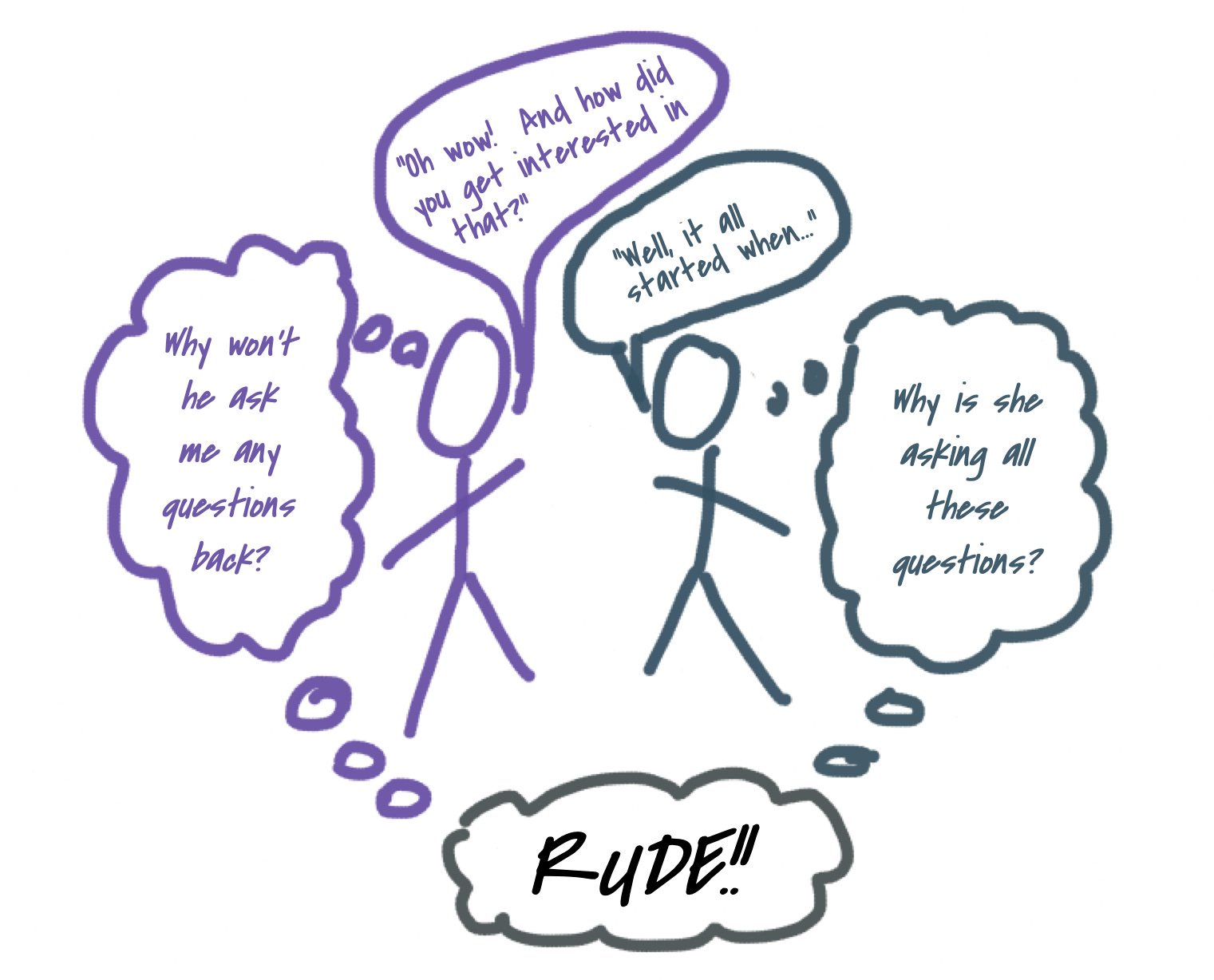
The existence of these conflicting paradigms dawned on me very slowly. In the microculture of my family of origin, dinner-table conversations primarily revolved around asking questions of one another, and this was doubly true when we had guests. Occasionally, someone I brought to dinner would ask me afterwards why my family was “grilling” them, but I would just laugh and try to explain it’s our way of welcoming a new person – not understanding in the least why they might not receive it that way.
At the same time, I noticed that some people did seem to have another paradigm: one in which conversations were mostly carried on by everyone volunteering information and opinions. I generally felt too self-conscious to follow suit, so I tried to express interest, while my hopes of being asked questions in return were mostly disappointed. (I never claimed that adherents of the “asking” paradigm don’t want to talk about themselves too. ;)
I started to try to name and describe what I was experiencing as the clash between “asking” and “sharing” paradigms. With significant others and close friends over the years, I would sometimes venture to suggest, cringingly, how I’d love for them to reciprocate when I ask them about their thoughts and feelings, or ask how a major event had gone when they saw me afterwards.
But it wasn’t until embarrassingly recently that I came to remotely grasp what the “sharing” paradigm is all about – after (like a true asker) grilling my partner’s friends from his Midwestern childhood. Some of these kind, gentle souls explained more about how conversations feel for someone raised in a sharing paradigm, and what the predominant concerns of this paradigm are with regard to politeness. I had totally missed that the generosity of the sharing paradigm consists in avoiding intrusion, respecting boundaries, and giving space. Avoiding making the other person uncomfortable by accidentally probing something they might not want to talk about. Volunteering to open up about yourself as a way of gently building rapport. My asking little mind was blown.
After further non-scientific consultation with friends and family, it seems like the two paradigms operate more or less like this, with regard to how personal information (e.g., thoughts, feelings, experiences, etc.) is elicited or shared in friendly conversations:
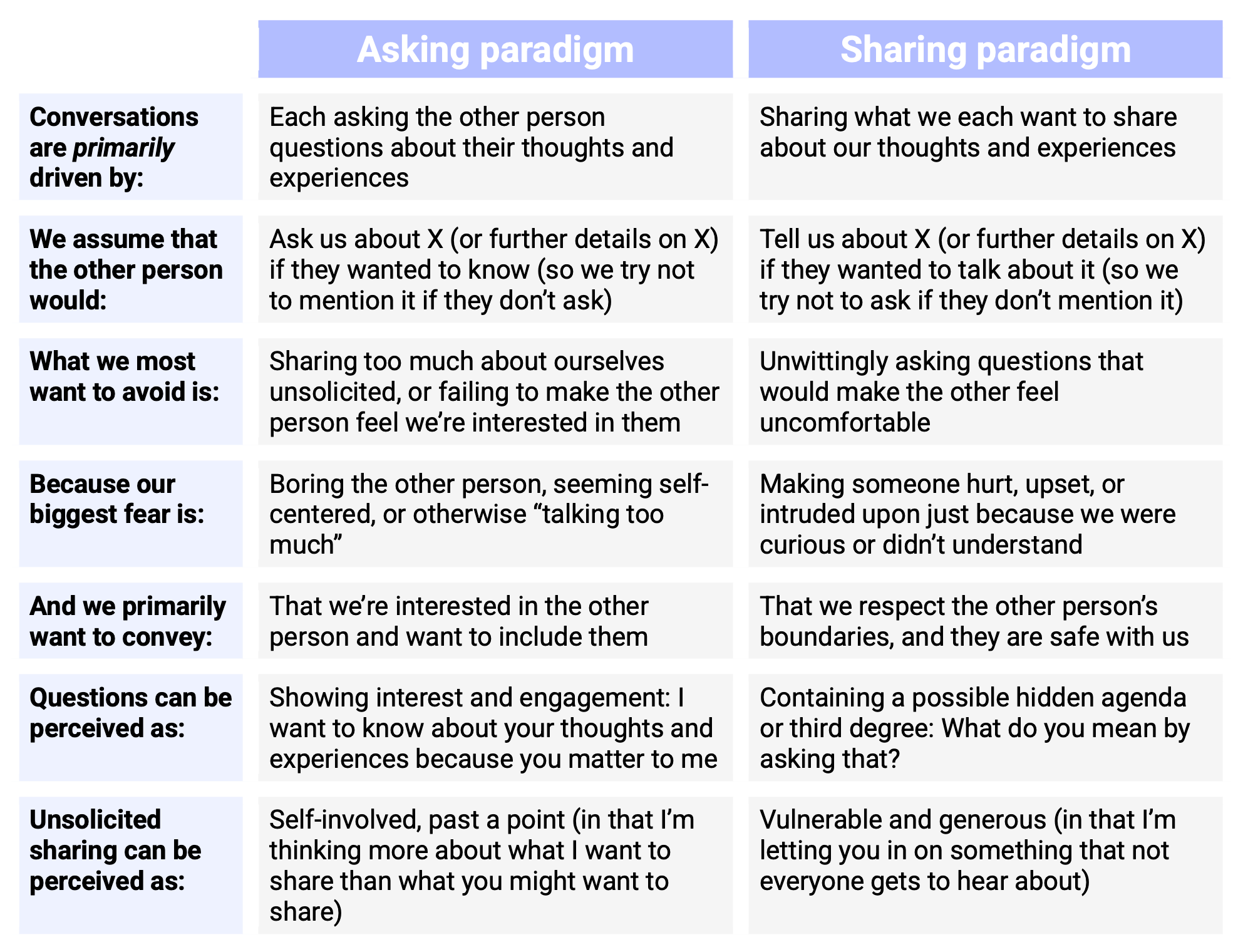
Just a couple of weeks ago, I came across “politeness theory”, a school of thought within linguistic anthropology set forth in the 1980s by Penelope Brown and Stephen Levinson. Arguably, there could be at least a distant relationship between asking versus sharing paradigms for polite conversations and what Brown and Levinson described as “positive face” and “negative face,” or the desire to be liked and approved of versus the desire not to be impeded or intruded upon. While both of these concerns are inherent in politeness itself, and both are central to both askers and sharers, it might be that the sharing paradigm concerns itself more with not intruding on a person’s boundaries by asking the wrong questions – in other words, not wanting to pry. The asking paradigm, meanwhile, seems to be more concerned with proactively showing interest in a person, wanting to make them feel important and included. Maybe, in fact, these boil down to different views on how best to take the initiative to forge a connection: to ask, in order to affirm our interest, or to share, lest we intrude.
The asking and sharing paradigms are not two neat boxes, but a fluid spectrum, and a person might hop around a bit along that spectrum from one situation to the next. And, of course, even the most inveterate askers will do some sharing, and vice versa. Neither is inherently better, although most people will feel more comfortable with whichever paradigm they grew up with predominantly. But understanding that these two often-conflicting paradigms exist can help us to recognize and appreciate them when we encounter them, and hopefully to reduce misunderstandings.
Thank you for this piece. I appreciate the framework you provided for giving the benefit of the doubt to another person when finding oneself feeling either like an over-sharer or a cross-examiner about whom no one holds curiosity. I am trying to think of gentle bridges to overcome a perceived impasse. Many people I know (myself included) have sometimes interpreted a lack of mutuality in conversation as being in the other’s blind spot reflecting an unconscious bias. “I never thought to invite you to the [otherwise same-sex, race, age, or other identity] gathering” but on an individual level. “I am not curious about you because I don’t think there is anything for me.” I appreciate this alternative way of conceptualizing while also wanting to tease out the nuances.